This week, we received a great question on Twitter: “You guys talk about height and weight a lot. But just curious, why are college quarterbacks supposed to be at least 6’1”?”
It’s a question that comes up constantly when discussing the physical attributes of successful quarterbacks, especially in college football. And the answer isn’t some old-school scouting cliché passed down from a guy who once saw Joe Montana play and decided tall was good. There’s actual math behind this. Like, trigonometry-your-high-school-teacher-would-be-proud math. Like, tangent functions and angle-of-sight calculations and the kind of geometry that makes people’s eyes glaze over at parties (we’re very fun at parties, by the way).
So let’s break it down.
The Role of Height in a QB’s Success
Height is more than just a number on a roster. For quarterbacks, height plays a critical role in their ability to see the field, make quick decisions, and execute plays.
The average height of D1 offensive linemen sits between 6’3” and 6’5”, and that number is trending upward. FBS starting offensive linemen averaged 6’4.5” in 2023 across all 133 programs, with Power 5 conferences skewing taller. Big Ten lines averaged 6’5.1”. Ohio State’s projected 2025 starters averaged 6’5.4”. Georgia’s 2024 offensive line recruiting class averaged a casual 6’7”, 340 pounds, which is less “football player” and more “they’re building actual walls out of human beings in Athens.”
When a quarterback is too short, their line of sight is directly impacted - they struggle to see over the linemen, which limits their ability to spot open receivers or anticipate defensive movements. These aren’t nameless, faceless blockers. These are 6’5” humans wearing two-inch helmets standing directly in your line of sight. The wall is real, it’s enormous, and it doesn’t care about your 247Sports composite rating.
However, there is a caveat.
The Caveat: The Diminishing Role of Height With Regard to Throwing
In today’s game, the impact of a quarterback’s height is genuinely diminishing when it comes to throwing over linemen. Modern QBs have become increasingly adept at adjusting their arm angles, allowing them to find passing lanes regardless of height. Patrick Mahomes (who grew up in MLB clubhouses watching his dad throw baseballs from every conceivable arm slot) basically rewrote the quarterback mechanics textbook. The guy throws sidearm, underhand, off-platform, from one foot, probably while doing his taxes. His 2019 season saw 484 pass attempts with only 6 batted at the line. Six. That’s a rounding error.
And the ripple effect has been enormous. At the Manning Passing Academy, arm angles are all over the place now. Over-the-top, three-quarters, sidearm. QB coaches are devoting roughly a third of practice time to off-platform throws and nontraditional arm slots. Aaron Rodgers developed his signature “foot pop” release. Joe Burrow throws from angles that would’ve gotten you benched in 2005. The old “plant your feet and throw over the top” coaching gospel is dying, and the varied release points mean quarterbacks can throw around obstacles instead of needing to arc the ball over them.
This ability to change the trajectory and angle of throws makes it less critical to be able to throw directly over linemen. The mechanical revolution is real, and it’s partially rewriting the height equation.
But only partially. Because here’s the thing everyone glosses over.
Why Height Still Matters: Understanding the Tangent and Angle Concept
When we talk about a quarterback needing to see over their linemen, we’re talking about geometry. Not metaphorical geometry. Not “he’s got good field vision” hand-waving. Actual, calculable, your-TI-84-could-solve-this geometry.
Imagine the QB’s eyes as a point that creates a line extending outward from their face, going over the heads of the linemen in front of them. For the quarterback to see over the linemen, that line needs to be angled slightly upward. Just enough to clear the top of the linemen’s heads and let the QB see what’s happening on the field beyond them.
This upward tilt is what we call the angle of sight. The angle of sight can be really small, like 1 to 2 degrees, but it makes a massive difference in how the geometry plays out. And this is where people’s intuition fails them, because human brains are terrible at thinking about small angles over distance.
Think of it this way. If you’re standing directly behind someone one inch taller than you, they’re a wall. You can’t see anything past them. But back up 10 yards, and suddenly that same person barely blocks anything in your visual field. Back up 50 yards and they’re a speck. Distance flattens the angle. That’s not controversial, that’s not debatable, that’s trigonometry. The farther back you stand from an obstacle, the less of your visual field it occupies, and the shallower the angle your eyes need to tilt upward to clear it.
This is exactly why shotgun depth matters so much in the height conversation, and it’s exactly why the 6’1” threshold isn’t arbitrary.
What Is Tangent?
In geometry, the tangent (often written as “tan”) is a function that relates the angle of sight to how far back the QB needs to stand. It measures how steep that line from the QB’s eyes to the top of the linemen’s heads is.
So if the linemen are much taller than the QB, the QB has to stand further back to make that angle small enough to see over them. Conversely, if the QB is taller (and his eyes are closer to the height of the linemen), the angle flattens out and he needs less distance to achieve clearance.
One important note here: your eyes aren’t at the top of your head. They sit roughly 4 to 4.5 inches below your listed height. So a QB listed at 6’1” (73 inches) has an eye height of approximately 68.5 inches. He “sees from” about 5’8.5”. A 6’0” QB sees from roughly 5’7.5”. That one inch of listed height is one inch of eye height, and as we’re about to show you, one inch can be the entire ballgame.
How Does This Work for a QB?
Let’s say you’re a QB who’s 5’8” and your linemen are 6’3”. There’s a significant gap between your eye height and the top of the linemen’s heads. To see over them, you’d have to tilt your line of sight upward at a certain angle. The steeper that angle, the less far back you need to stand to clear the linemen’s heads.
But here’s the catch: a small angle, which is what’s needed for most short to mid-range throws (like 1-2 degrees), means you have to stand much further back to achieve that clearance, because the line from your eyes takes longer to “climb over” the linemen. When we’re talking about seeing over linemen, we don’t want to be looking at the sky, since there are no receivers up there (aside from our dearly departed WR brethren, rest in peace). That angle needs to be as small as possible to actually let you read the field at a useful depth.
And this is where it gets beautiful.
The Chart That Explains Everything
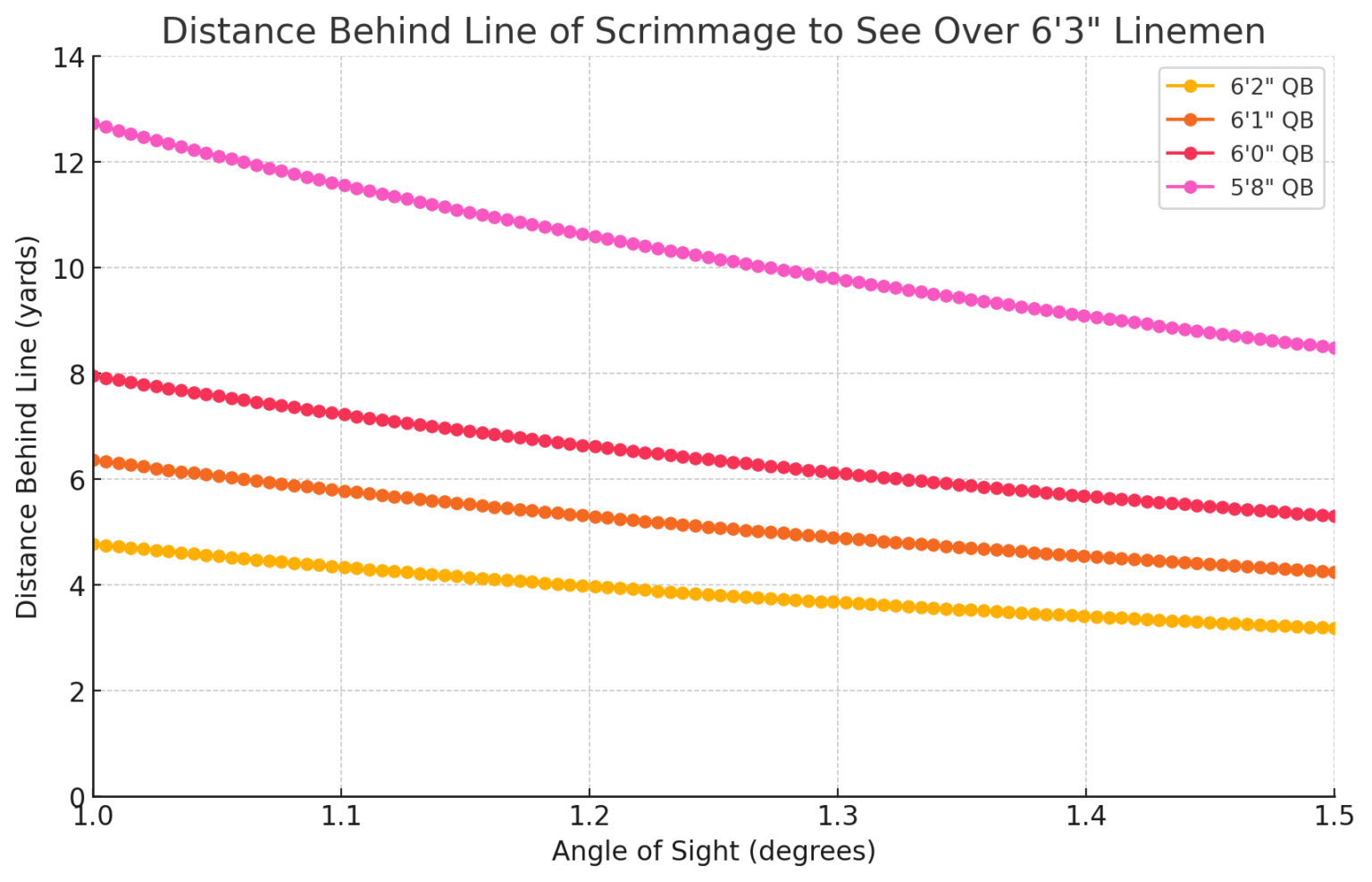
Just look at the chart at the top of the page.
It is no coincidence that at 1.5 degrees, a 6’1” QB at EXACTLY shotgun depth can see over the average lineman, but a 6’0” QB cannot.
Read that again. At the specific angle that matters for reading short-to-intermediate routes (1.5 degrees), the geometry breaks in favor of the 6’1” quarterback at standard shotgun depth (roughly 5 yards behind center). Drop one inch to 6’0”, and the math stops working. The angle gets too steep, or the required depth gets too deep, or both.
This isn’t some arbitrary scouting threshold that got passed around enough times that everyone believed it. It’s not an old wives’ tale. It’s not “well, Peyton Manning was tall and he was good, so tall must be good.” It’s the tangent function doing what the tangent function does, and the answer it spits out says 6’1” at shotgun depth is where the geometry starts cooperating.
Is this a hard and fast rule? Absolutely not. Plenty of quarterbacks under 6’1” have succeeded. The mechanical revolution in arm angles, the dominance of shotgun and spread formations, RPO concepts that reduce the need to read over the line - all of these mitigate the geometric penalty. But it’s not arbitrary either. The math is the math, and the math draws a line right around 6’1”.
The Release Point Problem: Why Throwing Matters Too
There’s another dimension to the height question that goes beyond sight lines, and it’s arguably the more impactful one: where the ball leaves your hand.
A quarterback’s release point height correlates directly with listed height. A 6’3” QB releases from roughly 7.25-7.5 feet. A 6’1” QB releases from about 7.0-7.25 feet. A 5’11” QB releases from approximately 6.75-7.0 feet. Meanwhile, a defensive lineman with hands raised reaches 8 to 9 feet. Nobody, not even 6’5” QBs, releases the ball above that ceiling.
The difference is trajectory. A taller quarterback can throw a flatter ball to the same target because his release point starts closer to the obstacle’s height. A shorter quarterback has to arc the ball more steeply to clear the same obstacle, and that steeper arc carries three compounding penalties:
First, it reduces horizontal velocity. More energy goes up instead of forward. Second, the ball hangs in the air longer, giving defensive backs additional reaction time. Third, it disrupts timing on short and intermediate routes where the difference between a completion and a pick is measured in tenths of a second.
This becomes a very real issue on short passes specifically, because it limits the amount of speed the quarterback can put on the ball. Deep balls? Everyone’s arcing those. But a 12-yard out route that needs to arrive as a rope? The guy releasing from 7.5 feet has a meaningful physics advantage over the guy releasing from 6.75 feet.
The Mahomes-style arm angle revolution mitigates this. Sidearm throws go around rather than over, but it’s a compensation, not a complete solution. Not every quarterback has the proprioceptive talent to throw accurately from five different arm slots while a 280-pound defensive end tries to redistribute their skeletal structure.
So How Tall Are Colorado Prep QBs?
Here is a chart of every Colorado prep quarterback who completed a pass last season. Average height? Between 6’0” and 6’1”.
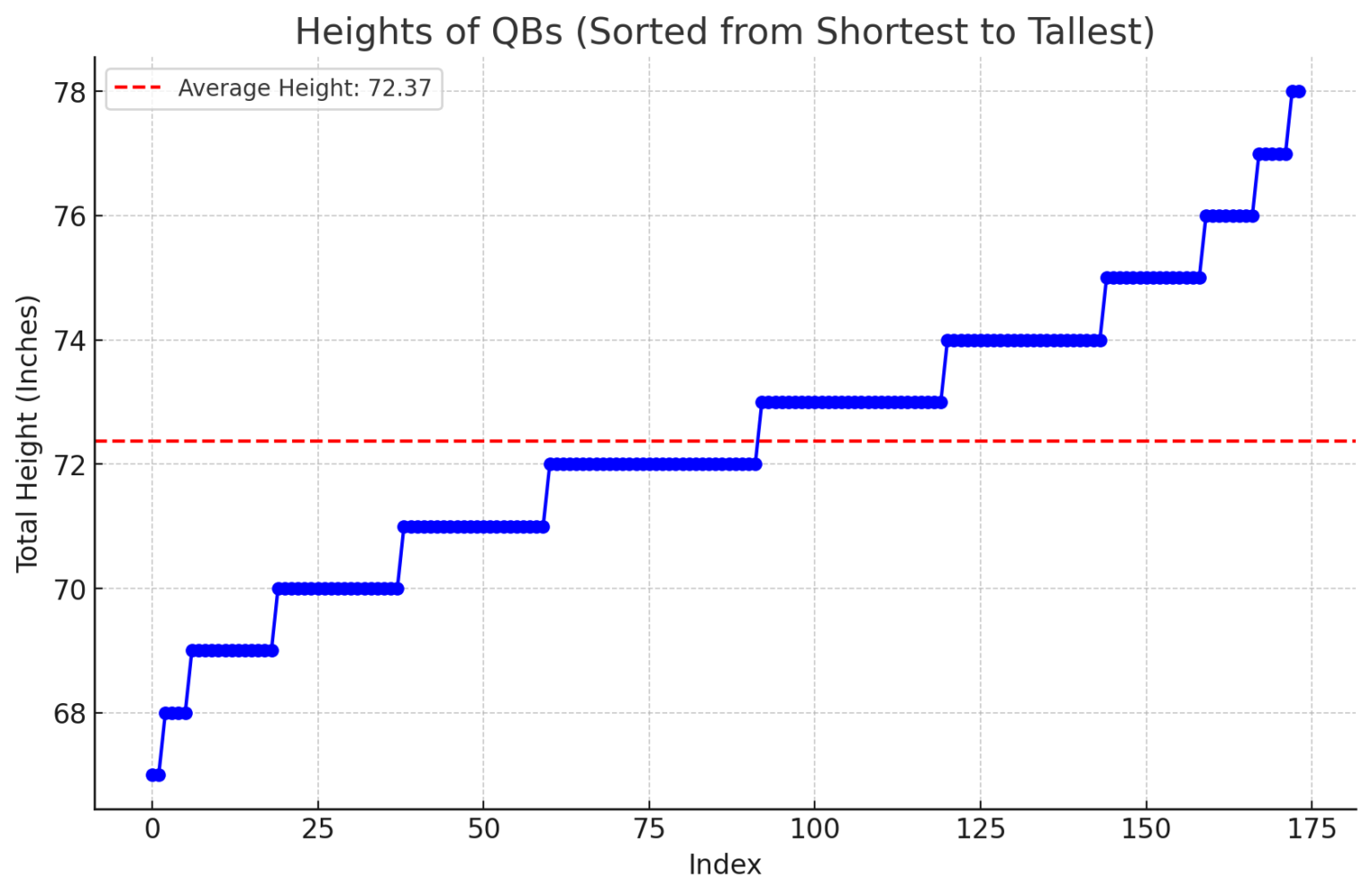
That’s the state average. The geometric floor for college quarterbacks, right there in the data from your own backyard. The guys who end up playing at the next level tend to be on the 6’1” side of that average or above. The guys who don’t tend to be on the 6’0” side or below. Not because scouts are heightist (though some are), but because the trigonometry starts penalizing you below that line and the margin for error at the college level is already razor-thin.
Impact on Completion Percentages
Below is the completion percentage data for all Colorado QBs who threw for at least 50 yards last season.
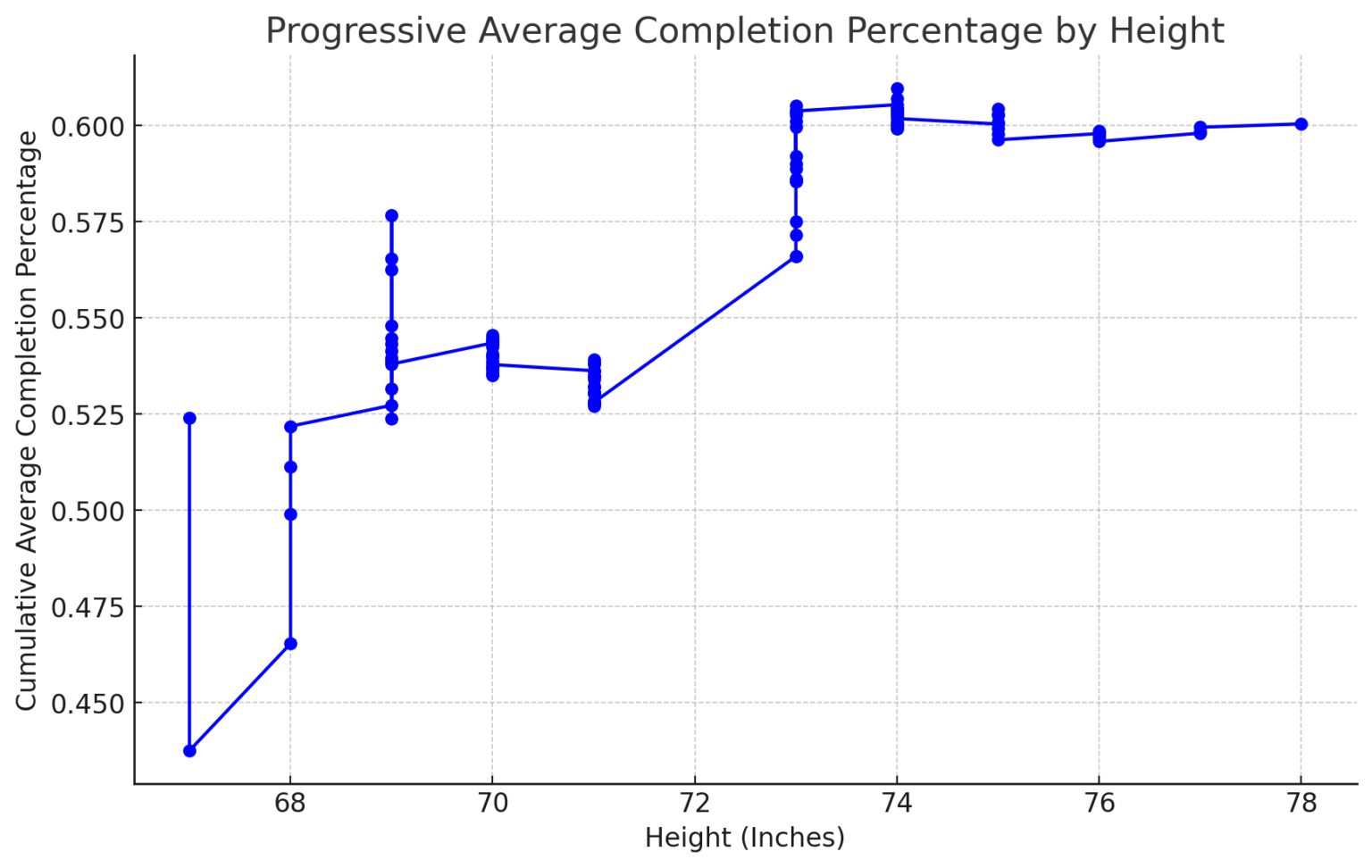
We’re not going to oversell what this shows. Completion percentage is influenced by about forty-seven thousand variables including receiver talent, offensive scheme, defensive quality, weather, whether the QB had a fight with his girlfriend before the game, etc. But the trend is there, and it aligns with what the geometry predicts: the height sweet spot for production clusters right around where the tangent math says the pocket geometry starts working.
The Bottom Line
The 6’1” threshold for college quarterbacks isn’t a tradition. It isn’t a bias. It isn’t some crusty scout’s preference dressed up as wisdom. It’s the output of a tangent function applied to the real-world measurements of offensive linemen, standard shotgun depth, and the small angles that matter for reading a football field.
At 6’1” and shotgun depth, the geometry cooperates. At 6’0”, it doesn’t. The modern game has developed workarounds (varied arm angles, spread formations, RPOs), and those workarounds have enabled shorter quarterbacks to succeed. But they’re compensations for a geometric penalty, not eliminations of it.
So the next time someone asks why college QBs are “supposed to be” at least 6’1”, you don’t need to cite Drew Brees or Russell Wilson or argue about whether height matters. Just hand them a protractor and a tangent table.
The math already answered the question.